
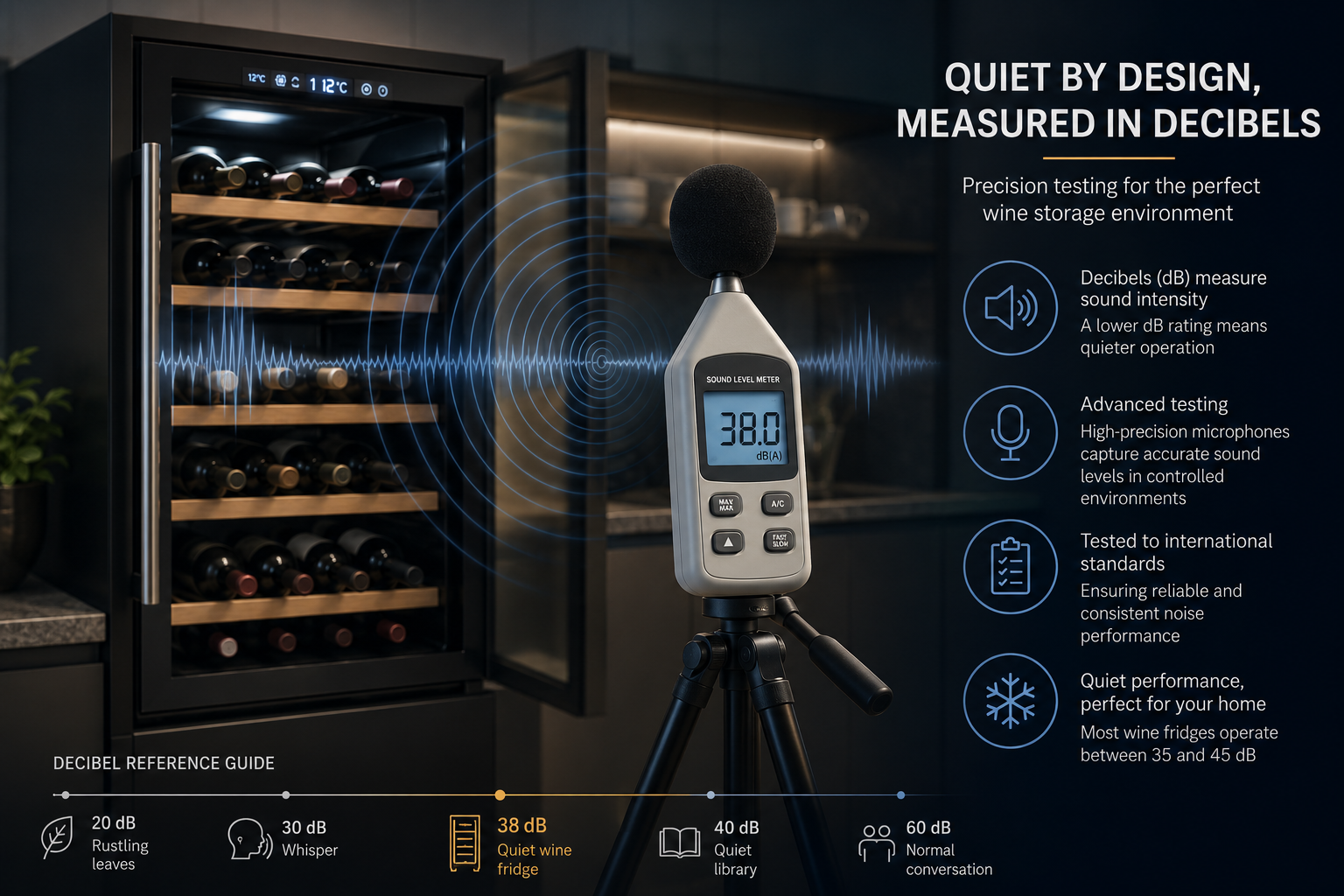
How Decibels Are Measured in the Manufacturing of Wine Fridges
Wine enthusiasts understand that temperature stability is essential for preserving the flavour and quality of fine wines but with that stability a compressor driven wine fridge will be needed. Compressor driven wine fridges can still be quiet wine fridges. However, another factor that plays a significant role in choosing wine storage is noise. Excessive vibration and sound generated by a wine fridge can potentially disturb sediment and affect the ageing process of certain wines. As a result, manufacturers place considerable emphasis on controlling and measuring noise levels throughout the production process. Central to this effort is the use of decibels, the standard unit used to quantify sound.
Understanding Decibels
A decibel (dB) is a logarithmic unit used to measure sound intensity. Unlike a linear scale, the decibel scale reflects the way human hearing perceives changes in sound. A small increase in decibels can represent a substantial increase in actual sound energy.
For reference:
-
20 dB is roughly equivalent to rustling leaves.
-
30 dB resembles a whisper.
-
40 dB is similar to the ambience of a quiet library.
-
60 dB corresponds to normal conversation.
Most mid-premium wine fridges are designed to operate between 35 and 40 dB, allowing them to run quietly in kitchens, dining rooms and living spaces.
Why Noise Matters in Wine Refrigeration
Noise control is more than a matter of consumer comfort. Wine storage environments benefit from minimal vibration and disturbance. Compressors, cooling fans and airflow systems can all generate sound and vibration that may interfere with the long-term ageing of wine.
Consumers are also increasingly installing wine fridges in open-plan homes, entertainment areas and luxury kitchens where low noise levels are highly desirable. Consequently, manufacturers compete not only on cooling performance and capacity but also on acoustic performance.
To ensure products meet customer expectations, noise measurements are integrated throughout the design and manufacturing process.
Sources of Noise in Wine Fridges
Several components contribute to the overall sound profile of a wine cooler.
Compressor Systems
Traditional compressor-based wine fridges rely on a motor-driven compressor to circulate refrigerant. Compressors are often the largest source of operational noise. Their cycling behaviour, mounting system and internal design all influence decibel output.
Manufacturers employ vibration-dampening materials and advanced compressor technologies to minimise sound generation.
Cooling Fans
Fans distribute cold air evenly throughout the cabinet. Although essential for maintaining consistent temperatures, fan blades and motors can create audible noise. Engineers carefully select fan sizes, speeds and blade geometries to reduce acoustic emissions.
Refrigerant Flow
As refrigerant expands and contracts through the cooling system, subtle clicking, bubbling or humming sounds may occur. These noises are generally normal but are monitored during quality control procedures.
Structural Resonance
Metal panels, shelves and cabinet frames can amplify vibrations. Engineers use insulation materials and structural reinforcements to absorb resonant frequencies and maintain quiet operation.
Measuring Sound During Product Development
Before mass production begins, engineers conduct extensive acoustic testing. Sound measurements are typically carried out in controlled environments that minimise external interference.
Specialised microphones and sound level meters capture the sound pressure generated by the appliance. Measurements are recorded in decibels and analysed to identify dominant frequencies and noise sources.
Acoustic engineers evaluate the appliance under various operating conditions, including:
-
Compressor start-up.
-
Steady-state cooling.
-
Fan operation.
-
Defrost cycles.
-
Temperature recovery after door openings.
These tests help engineers refine components and improve overall acoustic performance.
Sound Level Meters and Their Role
Sound level meters are the primary instruments used to measure noise. These devices contain highly sensitive microphones that convert pressure variations in the air into electrical signals.
The meter processes these signals and displays a decibel reading. Manufacturers often use A-weighted measurements, represented as dB(A), which approximate how the human ear perceives sound.
A-weighted measurements place greater emphasis on frequencies that humans hear most easily while reducing the influence of extremely low and high frequencies.
For example, a wine fridge advertised at 38 dB generally refers to a measurement of 38 dB(A).
Testing Environments
Accurate acoustic measurements require carefully controlled surroundings. Manufacturers frequently use acoustic laboratories and anechoic chambers.
Anechoic Chambers
An anechoic chamber is specifically designed to eliminate reflections and echoes. Walls are lined with sound-absorbing materials that create a nearly free-field environment.
These chambers allow engineers to isolate noise produced exclusively by the wine fridge without interference from external sounds.
Semi-Anechoic Rooms
Semi-anechoic rooms provide a more practical testing environment and are commonly used in appliance manufacturing. They simulate real-world conditions while maintaining sufficient acoustic accuracy.
Measurements obtained in these facilities help ensure consistency between laboratory results and consumer experiences.
International Standards and Compliance
Noise testing procedures are governed by internationally recognised standards. Organisations such as the International Organization for Standardization (ISO) and the International Electrotechnical Commission (IEC) establish methods for measuring appliance sound emissions.
These standards specify:
-
Microphone placement.
-
Ambient noise requirements.
-
Test room dimensions.
-
Operating conditions.
-
Calculation procedures.
Adherence to these guidelines ensures that noise ratings are comparable across manufacturers and product categories.
Manufacturing Quality Control
Acoustic testing does not end after product development. During manufacturing, quality control teams routinely inspect finished units to verify that noise levels remain within established specifications.
Sample units from production lines undergo sound measurements. If readings exceed acceptable limits, technicians investigate possible causes, such as:
-
Misaligned compressors.
-
Loose fan assemblies.
-
Insufficient insulation.
-
Defective bearings.
-
Improper mounting components.
Continuous monitoring helps maintain product consistency and reduce warranty claims.
Advances in Quiet Wine Fridge Technology
Consumer demand for quieter appliances has encouraged manufacturers to adopt innovative technologies.
Variable-Speed Compressors
Variable-speed compressors operate at lower and more consistent speeds than conventional systems. By avoiding abrupt starts and stops, they generate less noise and improve energy efficiency.
Thermoelectric Cooling
Some wine fridges use thermoelectric systems instead of compressors. These units rely on the Peltier effect and contain fewer moving parts, resulting in extremely quiet operation. Noise levels can fall below 30 dB in certain models.
However, thermoelectric systems are generally best suited to those wishing to keep their wines 'generally cool' as without a compressor these fridges can range + or - 6°C from their set point which isn't suitable for long term maturation.
Improved Insulation Materials
Modern acoustic insulation materials absorb vibrations before they spread through the cabinet structure. Rubber mounts, foam barriers and composite panels all contribute to lower decibel ratings.
Advanced Fan Designs
Engineers use computational fluid dynamics and aerodynamic blade shapes to optimise airflow while reducing turbulence and noise. Brushless DC motors further enhance quiet performance.
What Consumers Should Know
When comparing wine fridges, consumers should pay attention to the published decibel rating. Lower numbers generally indicate quieter operation, although differences of only a few decibels may not always be noticeable.
As a general guide:
-
Below 35 dB: Extremely quiet.
-
35–40 dB: Quiet and suitable for living areas.
-
40–45 dB: Moderate noise levels, ok for outbuildings or commercial settings.
-
Above 45 dB: More noticeable operation only suitable in noisy areas like restaurants or hotels.
Consumers should also consider room acoustics, installation conditions and ventilation requirements, as these factors can influence perceived noise.
Conclusion
Decibel measurement is a crucial aspect of wine fridge manufacturing. From research and development to final quality control, manufacturers employ sophisticated instruments and internationally recognised testing standards to ensure their products deliver both effective cooling and quiet operation.
By carefully analysing compressor behaviour, fan performance, structural vibrations and airflow dynamics, engineers continually improve acoustic efficiency. The result is a new generation of wine fridges that preserves valuable collections while operating with minimal noise, making them well suited to modern homes and premium living spaces.
As technology advances, the pursuit of quieter and more efficient wine refrigeration systems will remain a key area of innovation, with precise decibel measurement continuing to play a central role in the manufacturing process.